Signed in as:
filler@godaddy.com

Dr. Lauren McNamara is an American-Canadian learning scientist and educational researcher, consultant, and Ashoka Fellow whose award-winning work advances belonging, well-being, human development, and the everyday environments that shape children's lives.
Based in Scottsdale, Arizona, she earned an MS in Learning Sciences from Northwestern University's School of Education and Social Policy and a PhD from the Faculty of Education at Simon Fraser University in British Columbia.
Dr. McNamara is most at home at the intersection of research and practice, where she works alongside leaders to translate evidence into meaningful and lasting change. Drawing on more than 30 years of experience across research, higher education, consulting, and systems change, she collaborates with school systems, governments, nonprofit organizations, and community partners across North America to strengthen the social and physical environments where children spend time every day, expanding opportunities for play, learning, recreation, belonging, and participation.
She serves as a Consulting Research Scientist and Visiting Scholar at Arizona State University while leading Schoolyards for Thought, through which she advises organizations across North America. She also established Recess Project, a university-school research collaboration that helped shape national conversations about recess and school environments; co-founded the Global Recess Alliance; led the development of Canada's National Position Statement on Recess; and serves as an invited member of the Royal Society of Canada's Working Group on Children and Schools.
Her research has appeared in peer-reviewed journals, including Journal of School Health, Health Promotion International, and FACETS, as well as professional publications, policy statements, and national reports. She is a sought-after keynote speaker, facilitator, and advisor whose work has been featured by the American Psychological Association, The Globe and Mail, CBC News, CBC Radio, Teach Smarter, and numerous national and international podcasts and professional publications.
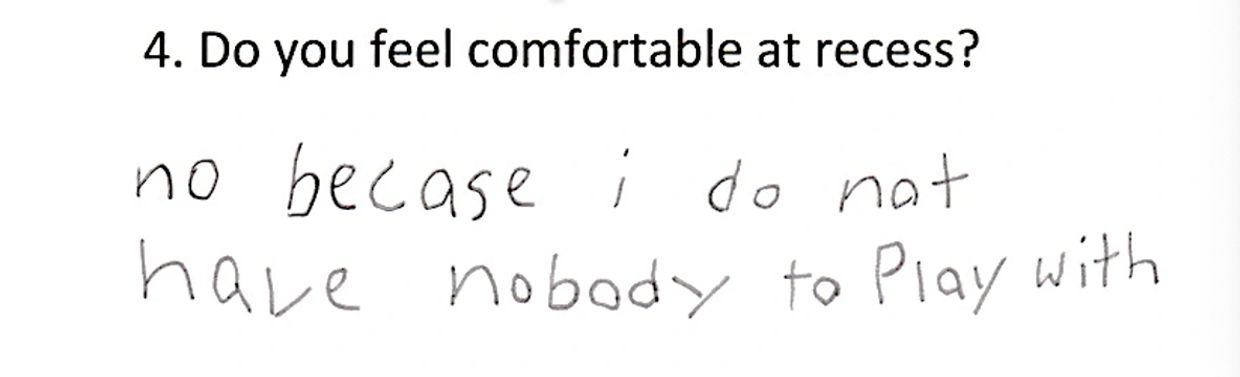
How do everyday environments shape belonging and participation?
What conditions support meaningful engagement and human development?
How do policies, design, and organizational norms influence experience?
What becomes possible when schools and public spaces are reimagined through a developmental lens?